
Toast POS system alternatives outside the US: what to compare
Toast is not sold in most countries. Here is what a restaurant elsewhere should check in any system it can buy: card payments, devices and how orders reach riders.
Home / Blog / Handheld POS system for restaurants: waiters' phones at the table
A handheld only speeds up a table when the round leaves the waiter's hand and reaches the kitchen by itself. Here is how a waiter's phone does that, and what it costs.
Agha Shah Zaman · Co-founder, Get Menu · 7 October 2026 · updated 16 October 2026
Tableside ordering on a handheld speeds up a table only when the round leaves the waiter's hand and reaches the kitchen by itself. GetMenu's handheld POS system for restaurants is the waiter's own phone. It shows the floor plan and sends each round to the kitchen. The round prints at the right station (kitchen, grill or bar) and shows on the kitchen screen. From the same phone, the waiter starts the bill.
A handheld POS for restaurants has one job: carry the order from the table to the kitchen without the waiter carrying it. If the waiter still has to walk to a fixed screen to send the order, the handheld saves nothing.
Studies show handhelds save time. FSR Magazine reported that Another Broken Egg's time study found handhelds cut ordering time by 3.6 minutes per group and let servers handle 12 percent more tables. Restaurant365's comparison says about 72% of restaurants now use handheld POS units for taking orders at the table or in the queue.
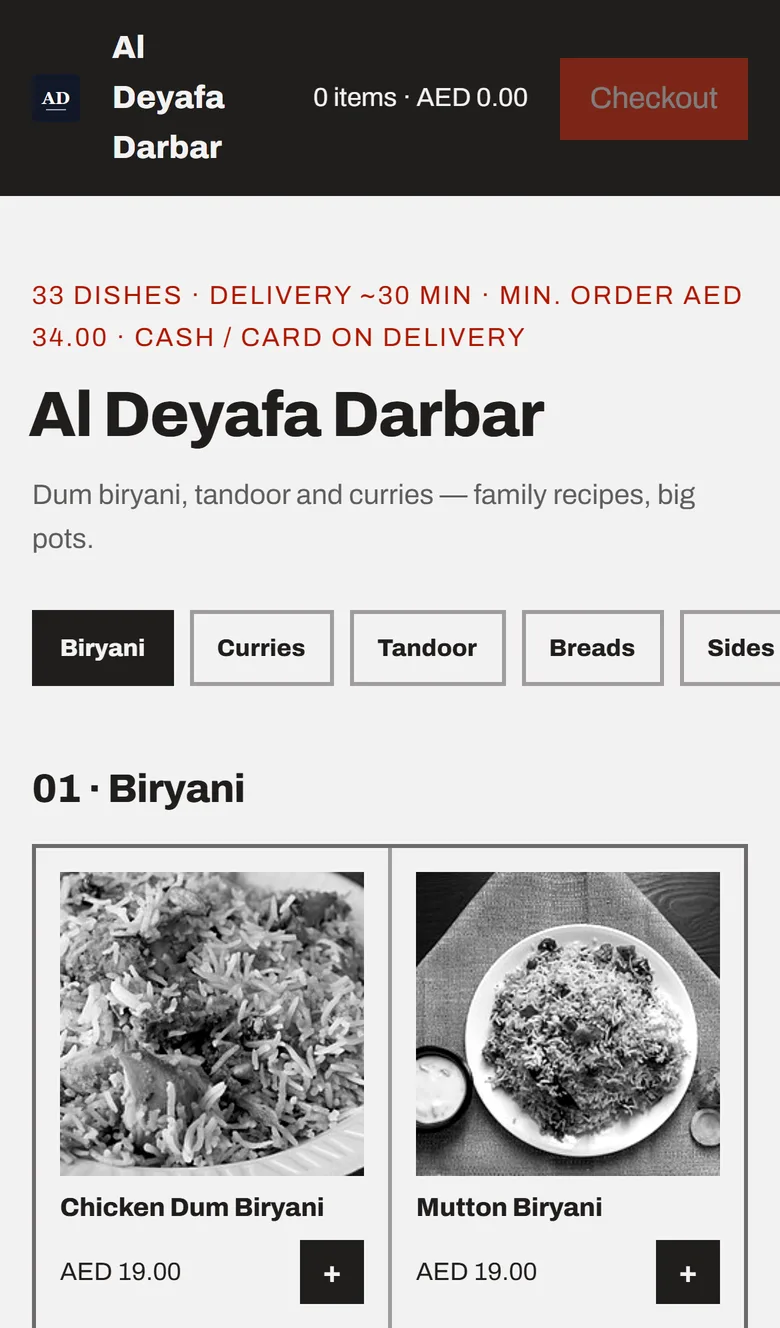
GetMenu's answer is a device kind called "A waiter's phone". Any iPhone or Android phone the waiter already has is paired to your restaurant with a six-character code from the dashboard. From then on it is a handheld ordering system for restaurants, with nothing to buy and nothing extra to charge overnight.
On the waiter's phone the first screen is your floor plan. You draw it once in the dashboard by dragging tables into place, and every device shows it. Tap a table, add dishes with their choices, such as the spice level, and send the round.
When the guests are ready to pay, the waiter starts the bill from the phone. The bill can be split by item or evenly, moved to another table, or merged with a neighbour's.
Two rules keep the money safe. A service charge on tables, anywhere from 0 to 20% with VAT inside it, is added to table bills and never to a counter sale. And a waiter's phone never opens the cash drawer. The drawer stays at the counter, where staff sign in with a four-digit PIN and a refund needs a manager.
Yes. Each round prints a ticket at the printer of each station, the same as counter, web and WhatsApp orders. Every station's ticket carries the same order number and no prices, and the choices are printed in bold on the kitchen ticket.
The round also lands on the kitchen screen the moment it is sent. It has a green ring that turns amber as it nears 8 minutes and red when it is late. A second round later goes to the same table as its own ticket.
Printers connect by USB (on the LAN), network, Bluetooth and built-in. See POS hardware and printers for how each station gets its own printer.
Yes, when three things are true. The round reaches the kitchen without a walk, the bill can be started from the table, and the waiter is not typing anything twice. Table turnover means how fast a table is free for the next guests.
Vendors say handhelds let servers seat new guests 20 percent faster, as FSR reports. The Another Broken Egg study above measured the parts that can be timed: the ordering, and the number of tables each server can take. The reason is simple. The kitchen starts cooking while the waiter is still at the table, so the dish arrives earlier and the table is free earlier.
A handheld slows servers down when it copies every counter function onto a small screen. GetMenu's waiter phone does only the table's work: tables, rounds, choices and bills. The drawer and the shift stay at the counter.
Use a QR code for casual restaurants and busy terraces, and a handheld restaurant POS on the waiter's phone where the waiter helps guests choose. GetMenu runs both from one system.
With the QR code, guests order on their own phones. With the handheld, the waiter orders on the waiter's phone. Each table's QR code has its own code, so a guest scans it and orders without typing an address, because the table is the address. The order joins that table on the floor plan, beside the rounds the waiter sent, and the bill is paid at the POS. Many restaurants use both: the code for the first round, the waiter's phone for the second.
Table QR codes come with the Growth and Pro plans, and the tables on the floor plan come with the POS add-on. Our guide to QR code ordering for restaurant tables explains the QR side in full.
Purpose-built handhelds are sold as hardware you buy up front. Square lists its handheld and terminal on its own hardware comparison page. Toast's blog describes Toast Go 3 as a purpose-built restaurant handheld that works with Toast's POS and payments. So anyone searching for a Toast handheld POS is buying the device and the platform together.
GetMenu's handheld is the phone in the waiter's pocket. The POS is a yearly add-on on top of your plan. The tables and the floor plan the waiter's phone works from are part of the add-on. There is no limit on how many phones, tablets and kitchen screens you pair. A restaurant with six waiters pays nothing extra for six phones. The figures are on the pricing page in your currency.
The plan's 15-day trial needs no card; the POS add-on has no trial of its own.
Agha Shah Zaman, a co-founder of GetMenu and a business technology analyst, gives owners one piece of advice. "Do not spend your budget on new handhelds. Your waiters already carry good phones. Spend it on a printer for each kitchen station, because that is where a round saves the most time."
Pay at table means your own card machine goes to the table and the POS records how the bill was paid. The drawer opens at the counter on the ways of paying you choose, usually cash. There is no card reader on the phone and no online payment on the ordering page, so card fees stay with your own bank and card machine.
Receipts print at the counter, and a guest who gives a phone number can have the receipt on WhatsApp instead. At shift close the card machine's total for the day is typed in and sits beside the POS card total. The two totals are compared the same evening.
The waiter's phone reads the same menu as the counter and the online ordering page. You upload dishes from a spreadsheet instead of typing them, with options and add-ons at their own prices. Stock counts fall as orders come in, on one stock list for the counter and the online menu. When a dish shows None left on any POS device, it is taken off the other POS devices and off your online menu too.
Online and WhatsApp orders show on the POS screen beside counter sales and table tabs, and the kitchen gets the same ticket for each. Every special request is printed in bold on the kitchen ticket. A customer's note prints on it too, and an allergy note prints in bold red above the dishes. Each ticket says whether the order is for delivery, collection or a table. Our page on POS with online ordering shows the whole flow.
Phone orders are typed in at the POS, and the cashier sends delivery orders to a rider on WhatsApp from the POS. For delivery orders from the page, the managers' group and the riders' group get the order the moment it is placed. The building and unit number are picked at checkout. For delivery, friends can share one group order and pay one bill (Growth and Pro plans).
A double tap cannot order twice. On the Pro plan, regulars grow into tiers and the loyalty card keeps updating itself in Apple Wallet and Google Wallet.
A handheld POS is a device a waiter carries to take orders and send them to the kitchen from the table, instead of walking to a fixed screen. Some vendors sell a purpose-built handheld. GetMenu uses the waiter's own phone, paired to the restaurant with a six-character code and set up as a waiter's phone that shows the floor plan and sends rounds.
The waiter's phone needs a connection to send a round to the kitchen and to start a bill. So give the POS devices their own Wi-Fi network that guests cannot join. The counter is different: a counter sale made with no internet is kept on the device. It is sent when the connection returns, once and never twice.
Casual restaurants and terraces do well with a QR code, because guests order the moment they sit down. Restaurants where the waiter helps guests choose prefer the waiter's phone. GetMenu runs both from one system, so a table's QR order and the waiter's round land on the same table and the same kitchen ticket. Table QR ordering is on the Growth and Pro plans.
A purpose-built handheld is sold as hardware you buy up front, and Toast sells Toast Go 3 with its platform. GetMenu's handheld is the phone the waiter already owns, paired for free. The POS itself is a yearly add-on on top of your plan, with no limit on devices. The current price in your currency is on the pricing page.
Yes, when the round reaches the kitchen without a walk and the bill can be started from the table. Another Broken Egg's time study, reported by FSR Magazine, found handhelds cut ordering time by 3.6 minutes per group. Servers could also handle 12 percent more tables. The kitchen starts cooking while the waiter is still talking to the guests.
Yes. Any iPhone on iOS 16 or later or Android phone on Android 5.0 or later runs the GetMenu POS as a waiter's phone. Staff sign in with their own four-digit PIN, the phone shows only the table's work, and it never opens the drawer. If a waiter leaves, you disconnect their phone and switch them off in the dashboard, and their PIN stops working.
Toast is not sold in most countries. Here is what a restaurant elsewhere should check in any system it can buy: card payments, devices and how orders reach riders.
A QR code that only shows the menu still leaves guests waiting. A QR code that sends the order to the kitchen and the table's bill speeds up service. Here is how it works and how to set it up.