Home/Blog/Commission free online ordering system: what you really keep
Commission free online ordering system: what you really keep
Zero commission often means the fee moved somewhere else. Here is where it moves, what a restaurant really keeps with its own ordering page, and the benefits that matter more.
Anzul Aqeel · Founder & Director, Anunzio International FZC · 7 October 2026 · updated 16 October 2026
A commission free online ordering system is only free of commission when nothing else is charged per order: no service fee passed to the customer, no markup on card processing, no per-order "convenience" line. GetMenu's monthly plans are a flat price with nothing charged per order. No fee is ever added to the customer's order, and GetMenu's ordering page takes no online payment, so there is no processing to mark up.
Is a commission free online ordering system really free?
Usually not entirely, and the honest answer depends on where the money moved. Zero commission usually means one thing: the restaurant pays no per-order commission. The cost moves into a flat platform fee, a service fee passed to the customer, a processor markup, premium add-ons or contract minimums. The same guide gives an example of $80,000 in monthly sales. The yearly cost is about $4,200 on a flat-fee platform and $40,000 or more when many paid add-ons are stacked together.
Processing is the usual hiding place. ChowNow, which sells direct ordering on a flat subscription, lists its own processing on its blog at 2.95% plus $0.29 per transaction. That is not a trick; it is the cost of taking cards online, and it grows with your sales whatever the subscription says. A platform that adds a margin on top of the processor's rate has simply renamed its commission.
So read a zero commission promise with four questions. Is there a fee the customer pays per order? Is the card processing rate the processor's own, or marked up? Is there a per-order fixed fee? And is there a contract minimum? A platform that answers no to all four is commission-free in the way the words suggest.
What GetMenu charges, and what it does not
On the monthly plans, GetMenu charges a flat price, in your currency on the pricing page, and nothing per order. For kitchens a monthly plan does not suit, the same page lists a pay-per-order option: a small fixed amount per order, never a percentage. On either one, the customer pays no fee. There is no processing markup, because your own ordering page takes no online payment. Customers pay cash or by card machine when the order arrives, through the card machine your bank already gave you.
That is what the four questions look like answered. The checkout shows the customer a subtotal, the delivery fee for their building, which you set, and the total. If you offer free delivery over an amount, the cart shows how much more gets it. Nothing the customer did not choose is ever added to the total.
The order summary a customer sees: the subtotal, the delivery line and the total, with no service fee
What you keep when you stop paying per order
What you keep is the commission, which one fee guide puts at 15 to 30% per order on both Uber Eats and DoorDash, before service fees and promotions. On your own page that percentage stays in the kitchen. The saving is biggest on regular customers, because they would order from you without the app taking its cut.
You also keep the customer. On an app the customer belongs to the app; on your page they give their name and WhatsApp number once, and the page remembers them on their own phone for the next order. The confirmation comes from your own WhatsApp number the moment the order is placed, and so does every status update, so the relationship is yours to keep.
You set your direct prices. You can keep them a little lower than the app's and still keep more of each order, because no commission is taken. The price shown is the price charged: every line is re-priced from your menu at checkout, and a double tap cannot order twice.
What you still have to do yourself
A commission-free page does not deliver the food, and it does not bring in people who have never heard of you. Those are the two jobs the apps were doing for their commission, and you take them back.
Delivery is yours. GetMenu sends your riders' WhatsApp group a dispatch the moment the order is placed. It carries the building and unit number picked at checkout, the customer's map pin when they share their location, the phone, and whether to collect cash or bring the card machine. The rider taps one link to mark it delivered. But the riders are your riders, on your bikes. Phone orders typed in at the counter are sent to them the same way.
Finding new customers is also yours. The apps bring people who have never heard of you; your own page is where regulars order again. Many restaurants use both: the apps for the first order, a QR card in every app bag, and your own page from the second order. Orders from the delivery apps you connect through your own partner account sit on the same orders board as your own orders, and on the kitchen screen with the POS add-on, as the page on POS with online ordering explains.
The kitchen is the second. Upload the whole menu from a spreadsheet instead of typing it. Add options and extras, each with its own price. You can also make a choice required, such as the size, so the kitchen never gets an order without it. Stock counts fall as orders come in, and a dish at zero shows as sold out by itself. The managers' group gets a ticket for every online order. With the POS add-on, online and WhatsApp orders show on the POS screen beside counter sales, and every order prints on the same kitchen ticket at each station.
Repeat orders are the third. On the Pro plan, regulars grow into tiers with their own discounts, and the loyalty card in Apple Wallet and Google Wallet keeps updating itself. On the Growth and Pro plans, coupons and bundles you choose bring the price down. On every plan, a "Hungry again?" reminder reaches each customer at their usual mealtime after a delivered order, and a review request with your Google link goes out after delivery. On every monthly plan, invoices carry your TRN once you add it, and the customer can download the PDF without logging in.
Anzul Aqeel, the founder of GetMenu, started it after watching restaurants hand a quarter of every order to apps that kept the customer. "The commission was never the whole bill. The customer who belonged to somebody else was the expensive part."
Choosing a commission free online ordering system that stays that way
Ask every platform the four questions above, and get the answers in writing. Then ask what the system does after the order.
Does the confirmation come from your own number? Does the rider get the building and a pin? Does the customer have to install anything or create an account? Does stock fall when a dish runs out? GetMenu's answers are on its pricing page and in our guide to online ordering systems, and the trial runs 15 days with no card, which is long enough to see every fee that does or does not appear.
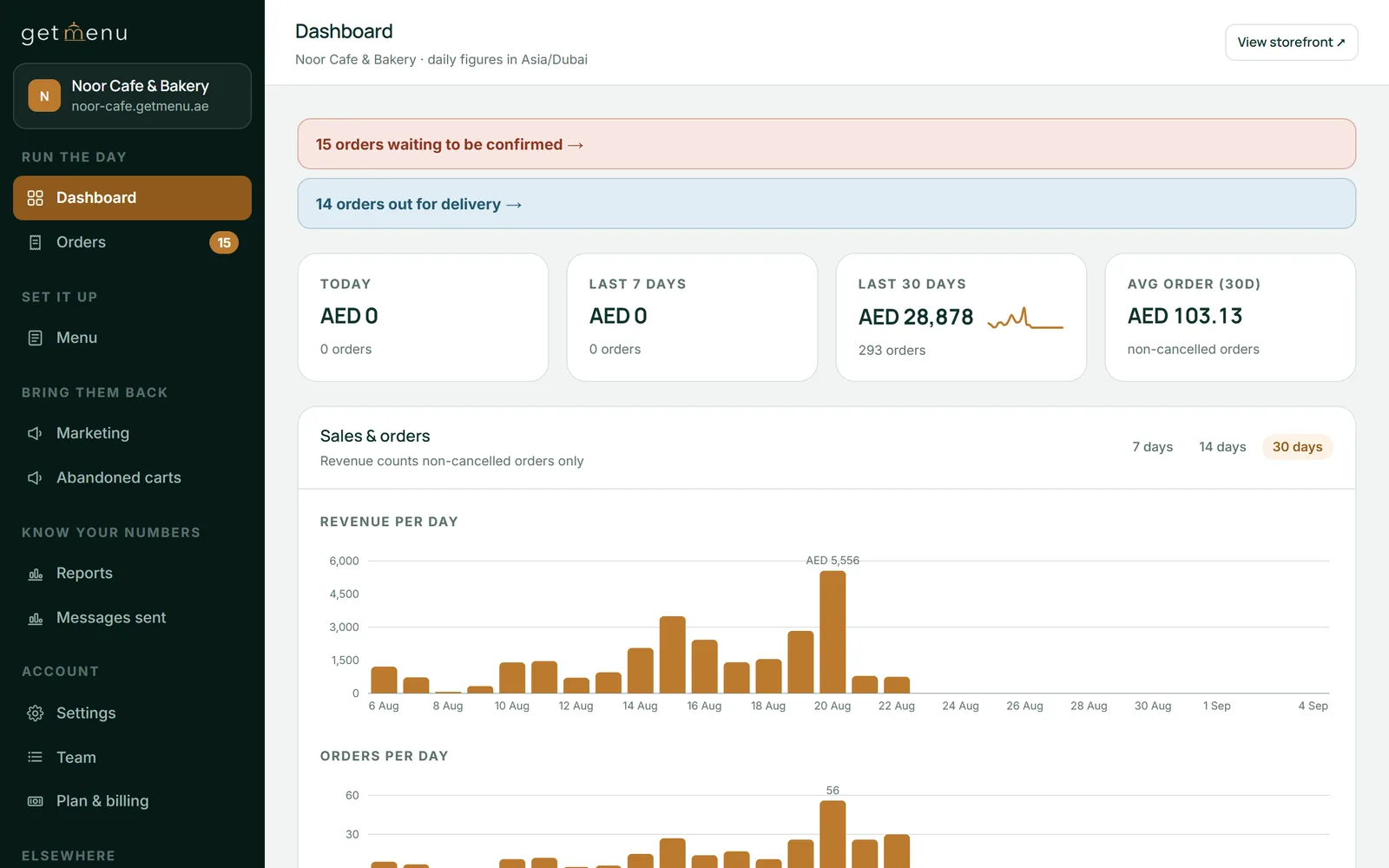
The Noor Cafe & Bakery dashboard: orders waiting to be confirmed, orders out for delivery, and sales for today, the last 7 days and the last 30 days
Frequently asked questions
Is 0% commission online ordering really free?
Often the commission has moved rather than gone: into a service fee the customer pays, a markup on card processing, a fixed fee per order, or a contract minimum. On GetMenu, customers pay cash or by card machine on delivery, so there is no online processing to mark up.
Do commission-free ordering systems charge the customer a service fee?
Some do, which is one of the places a commission hides: a percentage or a fixed amount added to the customer's total at checkout. On a GetMenu ordering page the customer sees the subtotal, the delivery fee for their building, which you set, and the total, with no service line. If you set free delivery over an amount, the cart shows how much more gets it.
Is a flat monthly fee cheaper than commission?
For most restaurants with regular customers, yes, because commission grows with every order and a flat fee does not. Work it out on a normal month: multiply your direct-order sales by the commission you would have paid. If that is higher than the monthly plan, the flat fee is cheaper.
What does commission-free mean for a restaurant?
It means the restaurant keeps the full price of each order on its own page. In return it does the two jobs the apps did for their commission: it delivers the food with its own riders, and it finds new customers itself, for example with a QR card in every app bag.
How much do delivery apps charge restaurants?
Commission is usually 15 to 30% of each order, with service fees and promotions on top, so the real cost per order often ends up higher. The exact rate depends on the app and the plan you signed. A regular who orders twice a month from your own page instead keeps that commission in your kitchen, which is why the QR card in the app bag matters.
How do I price my menu on my own page versus the apps?
Start from the price you want to keep. Many restaurants set app prices higher to cover the commission. Your own page has no commission to cover, so its menu price can be your counter price, and a regular sees the difference the first time they compare. GetMenu adds no fee to the customer's total, so the price on your page is the price they pay, plus the delivery fee you set for their building.
A checklist for choosing an online ordering system: what it asks before the order, how it handles options and stock, what happens the moment the order is placed, and who keeps the customer.